
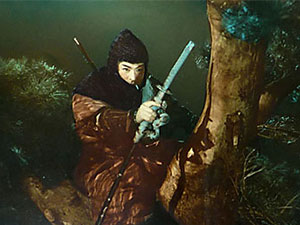
I think these still from the other Red Shadow, Akai Kageboshi, almost look better in B&W. The details of these astounding costumes are brought out better in higher contrast than they were in their decaying sepia-toned originals, which made up THE very first post ever on VN, back in June of 2009.


Y'know, almost a year ago I called this my favorite picture in my collection, and damn its still 100% true!
Posted 4 months, 1 week ago at 8:49 am. Add a comment
The cambara Lone Ranger looks pretty damn cool in B&W, too, like something off a Saturday matinee serial reel. Although the color originals of these images, first seen here in August of 2009, are absolutely stunning.


Kurotokagi has a great selection of Black Hood films from several decades – I recommend them all…
Posted 4 months, 1 week ago at 9:03 am. Add a comment

In looking at repurposing color images for B&W print ads, I tried to look for zones of photos that weren’t necessarily the original focus. Blowing up some of these areas produced a lot more grain, which when thrown into B&W makes these old Castle of Owls photos look even older. Love this detail above from the color original first seen here in September 2009.

As much as the print production artist in me loves the historical connection made by these mechanical pencil lines on the press photos, used by mural painters my guess, they are a real drag when you want to really see the image.


Flipped and tightened this one. Y'know, CASTLE OF OWLS would have made a damn good B&W movie.

I will never get tired of this image, in any form.
Posted 4 months, 1 week ago at 8:39 am. Add a comment
Couple weeks ago I was poking around with some B&W print ads using imagery from my Thai press kit collection – converting the decaying colors into more contrasty greyscale, exploring new crops, bringing out the grain and textures of the paper more, etc.
The results turn out to be a pretty interesting second look at some of the first stuff I ever did on VN, so I thought I’d share. This first batch is from Sengoku Yaro (Warring Clans), the color originals of which were featured back in June of 2009.
These particular exercises were in COMPOSITION.

The original full frame - a decent action shot, but lacks a real focus. You can, however...

...break this scene down in two different ways - one centering on actor Yuzo Kayama, the other...

...on the non-descript ninja he's about to dispatch. A whole different context.

The composition of this Yuriko Hoshi challenge pose is already great, but once again composition can hone in and change contexts.

This detail is actually a nifty little image on its own.

And this crop lets you see more of the hottie starlet, while still conveying the notion she's surrounded but defiant.
I also worked on some familiar images from Castle of Owls, Red Shadow and The Black Hood, all coming up over the course of the week.
Posted 4 months, 1 week ago at 7:27 pm. Add a comment
The 1957 Toei FX romp Ninjutsu Gozen-Jiai (aka Torawakamaru, the Koga Ninja) is the perfect example of the pre-60′s craze kid’s ninja film: mischievous wizard hero, evil sorcerer, spirit-creatures fighting in the clouds, etc and so forth. Before the real ninjutsu practitioners taught the makers of Shinobi-no-mono the real-deal, these magic duels were what the genre was all about.

These stills, contemporary with the film's release, are from a press kit for Asian secondary markets.

The film's dashing hero Torawakamaru (Sentaro Fushimi) has whatever magical powers he needs to in any given situation - teleportation, mind-over-matter, flight, and the requisite giant toad transmutation.

Here he is again, with the cute-as-a-button Ueki Chie as the princess-in-peril. Great costumes here.

Oddly enough, this film has the exact same historically-based conflict as the SHINOBI-NO-MONO films did years later: Tokugawa vs. Toyotomi, with Sandayu Momochi and Ichikawa Goemon (Nakajiro Tomita, in black above) working in the shadows.

Torawakamaru and Goemon's final duel goes from courtyard to rooftop and beyond. After a while, gotta think Japanese architects were reinforcing rooftops to accommodate constant combat...

A little closer in on these amazing costumes. Too bad both the film and the stills are B&W, the colors must have been intense.

In magic-based ninja flicks, ALL final duels end up in the clouds, or the shadow realm, or the zone of cloudy shadows, whatever. Shortly after this exchange, the combatants transformed into giant toad and fire breathing serpent, per union rules. No stills of such in the press kit alas.

Don't look to me for a rational explanation of this crudely composited still, I'm as baffled as you are. The kid is Goroichi (Ueki Motoharu), son on the evil Goemon. He, however, is the plucky boyscout/sidekick type, and the film is strangely brutal when it comes to the kid's emotions at watching his father's demise.
A movie (such as it is, with a serial-like running length of just over 1-hour) like this isn’t for those looking for the black suits and the blood-letting. It’s very one-dimensional, prone to silliness and comedy relief, and the FX scenes are a bit too few and far between. But, it is a prime example of what the genre was at the time. If you dig Magic Serpent, see it’s predecessor for sure.
Read Paghat’s review over at the Weird Wild Realm, along with pics of the toad and serpent.
Ninja Dojo write-up and link where to buy.
Posted 8 months, 1 week ago at 10:12 pm. Add a comment
…what movie (or movies) these are from, but they certainly are on-topic for the month!

Awesome hair, awesomer nose!

That's Ryutaro Otomo on the left, I believe. Guessing this is from late 50's or very early 60's, the pre-SHINOBI-NO-MONO years when ninja were still colorful swashbucklers, mischievous wizards, or both.

The crimson goblin get-up looks out of NINJUTSU SUIKODEN INAZUMA KOTENGU, but not the rest of the scene...

Again, these are from a cache of press kit still rescued from a Thai ad agency. The pencilled grid lines would have been reference for someone doing a wall-mural or large painted poster of the image triangle-by-triangle.


Everything seems to have worked out A-OK. Whole lotta oni masks in the one...
If anyone can shed some light on the images above, drop yer beloved e-publisher a line at unknownpubs-at-yahoo-dot-com.
Posted 10 months, 1 week ago at 9:15 am. Add a comment

The 1961 Satomi Kotaro adventure vehichle Kaiju Jaguma no Moshu (aka “Strike of the Jaguma”) is an absolute miracle of bizarre villains and over-the-top costuming. This has become cliche around here, but if the picture above isn’t enough to get you bouncing around the web in a buying frenzy, then you’re on the wrong site.
A gang of thugs is terrorizing local villages, but they aren’t just any hoodlums – their ranks wear ninja gear and masks, their leader is a whip-wielding fiend in an ornate demon get-up, and his number-one heavy is a white gorilla. Possibly a yeti. Or at least a guy in a yeti costume who’s REALLY dedicated to his gimmick and never takes it off. You be the judge…


These Thai press kit stills, contemporary to the film’s release, show the superb range of costuming, even for the un-masked hero. The hour-long film (probably run as a double bill) is a fine example of a frugal “programmer” that while often silly delivers on action and character design in droves. Flicks like this made a lot of kids wide-eyed and happy.


There are a couple of real ‘No f’n way!’ moments in this one – none more jaw-droppingly awesome than Kotaro’s dispatching of the white-gorilla-man-yeti-thing with, naturally, a gorilla-press slam that would make any pro wrestler proud.
For more, read Paghat’s review here, a French review here, and see a few screen caps here.
Posted 10 months, 3 weeks ago at 1:45 pm. Add a comment

Okamoto Kihachi‘s (Sword of Doom, Kiru!) 1963 ninja classic Sengoku Yaro is a real blast – a superb mix of comedy and combat, peppered with some rather outré fight scenes, a jazzy score by Masaru Sato that keeps you on your toes, and a super cute sword girl to boot.


The gorgeous YURIKO HOSHI, familiar to us from several Godzilla films, is sassy, defiant and deadly. The simple detail of the prop master giving her a shorter sword (a 'chisa' I think, or possibly a longer handled wakizashi?) actually does a lot to lend her sword acting some credibility.
These aging Thai press kit photos were contemporary with the film’s 1963 release. It’s a superbly shot B&W film, the colors here are actually hand tinted for display in theater lobbies. That moray pattern is from the acid fixer breaking down after half a century. These are in rough shape – never deigned for posterity, and nowhere near as collectible as their poster counterparts, thus rarely archived as well.

Who’s cooler than the film’s lead Yuzo Kayama? No-one, because not only was he in some kick-ass chambara and ninja flicks, he was also a great guitarist. That’s him below, on stage in Japan with the Ventures!

If you like films like Kiru! and 3 Outlaw Samurai, where the violence is tempered with sardonic humor, then Warring Clans is your ninja huckelberry. It’s got a great ‘who’s working who?’ dynamic familiar to the spaghetti westerns, and the fights are shot superbly.


LOVE that arrow stuck in the rain hood... That's MAKOTO SATO on the right, whose facial expressions alone lend an instant comedic edge to this film, putting it on a level above many of it's contemporary peers.


The battles in Clans are largely either on barren cliffsides or tall grassy plains infested with black-suited snakes ready to strike. The plot revolves around a caravan transporting rifles under siege from without and possibly within. At times, it’s a sort of buddy pic, with three bickering protagonists, all who claim to be the next leader of Japan, but who are actually bums… or are they?

From the, literally, explosive ending!
I’m tortured the press materials I scored didn’t include a shot of the astounding Kumi Mizuno, who has a small role. I mention her solely because I want an excuse to run this off-topic shot from my favorite mutation of the kaiju genre Matango:

There isn’t an angle I can’t recommend this movie on: The cinematography is top notch, and the fight scene editing is an absolute clinic in how to make non-martial artists look good in duels. It’s got some great ninja beats, too, although pretty much anyone in a black suit comes to a foul end. The flow of grave subject matter and at times gory violence with comedic performances in both small and main roles is masterfully executed. And if nothing else,you just cannot take your eyes off Yuriko Hoshi. She almost steals the movie…
Posted 1 year, 2 months ago at 11:41 pm. Add a comment

Can a respectable, accomplished beautiful woman from noble samurai family possibly say no to a hooded bedroom invader so clearly superior in his warrior fashion sense? I think not!
I may have started this site just to find a good home for this picture. Seriously.
Said hood is Hashizo Okawa, the shinobi son trying to exact revenge on behalf of his tattooed ninja mom-done-wrong in the 1961 Toei film Akai Kageboshi. It’s part tournament movie, part mulit-generational mystery, part ninja romance – all with a supporting cast of staggering chambara manliness.
It all starts with our old pal Hattori Hanzo, played by Jushiro Konoe of Ninja Hunt and the Yagu Secret Scrolls series, who intercepts a ninja on a castle incursion. During their struggle, he realizes his prey is actually a woman, and the two are so turned-on by each other’s shinobi sex appeal, they have at it on the spot.

Couple decades later, that same lady of the shadows is a bitter and obsessed ninja MILF who has trained her son, the offspring of that fateful encounter, in the family trade. Decked out in all sorts of gorgeous ornate get-ups, he is ‘The Red Shadow’ – the instrument of her revenge.

The plot, from that set-up, is full of twists and turns and amazing characters. Sonny-boy’s mission is to collect 10 swords, one of which has part of a map etched onto it’s handle that when matched up with mom’s killer tats will lead them to a Shogunate treasure and vindicate her failure as a shadow agent. The ten swords, however, are the prizes in a martial arts tournament, so Red has to snatch the blades from the victors every night.

This goes along fine, as long as the winners are old semi-retired swordsmen or young hotties practicing Naginata, but when one of the victors is Jubei F’N Yagu, played by Ryutaro Otomo, it’s a whole different deal!

Red throws everything in his ninja repertoire at Jubei, just to see it all bounce harmlessly off his square jaw. Jubei, meanwhile, butts his way into the intrigue afoot, then Hanzo comes out of retirement, Red falls in love, snakes fall from the ceiling and shuriken sing through the night air…

So yeah, Akai Kegeboshi is a pretty damn essential film, for those of you who haven’t seen it. Grey marketeers and fan-subbers have made it readily available, too, so there’s no excuses. Despite literal translations, would be a good idea to refer to this maybe as “The Crimson Shadow” or “The Scarlet Shadow” or something else, as the name “Red Shadow” has a rather significant pedigree elsewhere…
Here’s a ton of images, like the above, from Thai press kits released contemporary with the film’s original theatrical run.

Staged publicity shot, shows how amazing the costumes are in this film. That bo shuriken looks pretty deadly...

A staged combat shot from the publicity kit. AK is actually light on black-suited cannon fodder.

Hashizo Okawa publicity pose - check out the ornate fan designs on that tsuba!

That’s Keiko Okawa as Yuri, halberd expert and Shadow’s main squeeze.

Otomo's Jubei dispenses with the otherwise signature (maybe cliché) eyepatch for a perhaps more intimidating wink of doom. The film does a great job of portraying Yagyu as an omnipotent force of nature with a sword, and Shadow is in WAY over his head facing him.

Shadow is also no match one-on-one for the veteran Hanzo, it's everything he can do just to escape these encounters. And there are some really cool escapes, too.

The bit where someone has come so close to getting slashed in the head, their straw hat has a triangle cut in it is so damn cool...

Bit of a spoiler here, but it's not like you don't see it coming from a mile off. And yes, by contractual obligation, the final showdown is in the shadow of Mt. Fuji.


I’ll wrap this up with some close-up scans of the mission gear. LOVE that mesh soft-armor hood!


Don’t let these sepia-tone and B&W press photos fool you, Akai Kageboshi is a beautiful color film. The print that’s floating about the ‘trading communities’ is probably from TV and is pretty inky, though – but by no means a deal breaker.
SEE IT!
Posted 1 year, 3 months ago at 5:15 pm. Add a comment