
I’ve had this old beater copy of Zen Combat – Jay Gluck‘s ground-breaking 1962 treatise on Japanese martial arts – for years but never got around to cracking open its aging pages until recently. Finding a full chapter on ninja, written two decades before the craze, was a delightful surprise. It’s a very interesting read, for the information presented yes, but more for its warts-and-all attitude towards the then burgeoning Japanese ninja boom.
Zen Combat is a collection of new and re-purposed articles from late 50s/early 60s martial arts mags, which at the time were more like trade publications and newsletters for a community of professionals and ‘pro-sumers’ rather than the media-influenced glossy fare they became post Bruce Lee. Gluck was an Asian culture expert and practicing martial artist (travelling in circles with the great Mas Oyama) living part-time in Japan during a time when all things ninja were exploding in popularity. His poise is like that of an old-school Rolling Stones fan wading through a crowd of girls screaming for One Direction. The result is one of the more honest, if not overly skeptical essays on the matter you’ll find.
This article wasn’t a cover feature designed to sell magazine copies during a craze. There is no slant toward any emerging school, pressure from a publisher not to offend advertisers or effort to fan the flames of an exploding fad. For that, I think its a valuable read regardless if one agrees with Gluck’s findings.
The book is out of print, and the author no longer with us, so until Zen Combat becomes a commercial entity again, here’s scans of my vintage copy of the “The Magician: Ninjutsa” [sic] article. Have at it…
Gluck’s personal connection to shinobi history is little more than family anecdote, but the fish tales actually serve to illustrate a fundamental frustration with studying the moving target that is historical shadow arts and ancient espionage.
Gluck is a bit of a hater here, but aside from dispersions on “cockeyed karate” experts I really dig his analysis of “dirty weapons” and the practical truth behind alleged artifacts that populated the cases of the new wave of ninja museums and tourists attractions.
Interesting that despite looking down his nose at ninja-mania, Gluck isn’t a debunker. He buys into the black suit, and even makes parallels with kabuki stage blackout wear, but not a direct connection based on outright doubt as many have since.
Gluck also embraces the notions of specialized walks and runs as legit techniques of ninjutsu, seen in a lot of contemporary film and TV in “that man, he runs like a ninja” scenes. Check out Festival of Swordsmen or any of the Onmitsu Kensin (aka The Samurai) seasons for this.
I absolutely LOVE the line “People may look at him, but they will not see him,” which foreshadows similar notions Joseph Stefano wrote in “The Invisibles” episode of The Outer Limits two years later:
You do not know these men. You may have looked at them, but you did not see them. They are newspapers blowing down a gutter on a windy night.
and later,
You do not know these men. You may have looked at them, but you did not see them. They are the wind that blows newspapers down a gutter on a windy night — and sweeps the gutter clean.
Stephano’s prose served as the “control voice” narration at the beginning and end of an episode centered on secret government agents battling an even more secret alien invasion conspiracy. Their heroics will never be known to man, nor will the threat they defeated ever be realized by a public secure in its ignorance of what almost just went down.
The “control voice” lines could just as well describe the value of good ninja, whose genuine exploits are (perhaps to history’s benefit?) lost in the fog of family anecdotes, fish tales spun by fraudulent martial artists cashing in on fads and mass media whipping up a big craze. Or so Jay Gluck postulated…
I’d love to see what he would have written twenty years after the publication of Zen Combat. If Gluck was dubious of all the “last ninja” schools then, what would he have thought of what went down in the 80s?
Is it just me, or did the two piece hood common to North American merchandisers completely suck?
A mainstay of retailers like Asian World of Martial Arts, the common American ninja head gear was made of a heavy duty outer hood tied over a thin spandex/lycra balaclava. The under-mask was fine on it’s own, but the outer hood was a joke. It completely killed your peripheral vision and nothing really anchored it to the under piece, so the hood sometimes stayed in place when you turned your head, making the fit even worse.
Amazingly, ads like the above didn’t even hide those facts. Take a look at the illustration, you can see the lack of vision the crappy design provided. IN A DRAWING! The artist could have fixed that, portrayed them a little more functional, but no. He or she chose to stay accurate to what I’m guessing was photo reference, and clearly none of the subjects can see a thing.
I still have one of these suits (in black) from back in the day, and played with the hood a few years back for a photo shoot. It was just as shitty as I remembered. So we made this deal in all of 30 seconds with two 16″ pieces of black cotton fabric. Kinda makes the notion of buying a prefab hood silly…
Now on the other hand, these 80′s merch hoods always intrigued me:
I never saw these hoods in person, and am still really curious as to their quality. The big superhero-like logo on the forehead notwithstanding, they seems like a decent design, more or less out of Japanese 60s cinema.
If anyone had one of these or still does, comment below or drop us a line, I’d love to know more.
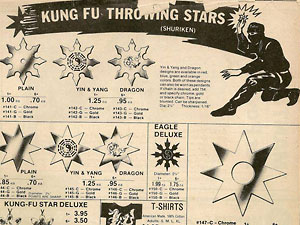
With the 80s craze came a lot of repurposed merchandise – stuff that for the previous decade’s boom had been sold as kung-fu gear now emblazoned with ninja logos. The above looks to have been a Chinese-esque design probably inspired by something David Carradine tossed around on network TV. But any 70s leftovers were given new life in the “ninja star” obsessed 80s.
The notion of shuriken pendants wasn’t exclusive to this company, either. In the dodgy swap meet, dirt mall, subway blanket, Chinatown video store realm you’d see full-size, razor sharp throwing stars with tiny holes hastily drilled into them somewhere to technically make them jewelry, not illegally sold weapons.
Now just what made a net a “Ninja Capture Net?” I don’t know, and I never this particular item, but I’m pretty certain it was some type of conventional fishing deal shinobi-fied for mail order. They made some pretty strong claims here about the net’s effectiveness. Not sure I’d trust something I mail-ordered for less than $15 against a “sword-weilding enemy.”
I also like their observation for item #704A – A black stick is invisible at night!
Nothing however, beats my all-time favorite piece of repurposed merchandise, the Ninja Boomerang.
Circa January, 1982, H. McMunn of New York sold two things: 17×22″ art prints and vicious caltrops. I’ve never sen these prints, or even good repros or scans of them, but I’m really curious about that one on top in what looks to be some sort of treasure room guarded by a giant anaconda.
As for ‘tetsu-bishi’ – Japanese caltrops – it’s one of those weapons that can only be unsafe. There’s no training version of these sole-takers, and even the poorest-made sharpened ‘jacks’ will tear your feet up if stepped on. They are one of the simplest and most effective escape tools ever devised, and I KNOW! One night back in the craze-80s, Tim threw toy jacks all over my bedroom rug, and I found out the hard way how much even a blunt toy KILLS when you step on it barefoot. Yeah, that’s my bestest pal ever people…
Man, how 80s would that satin jacket have been? And I wonder what “scribe-spike-etc.” were.
This is a pretty dumb ad – lots of vague category and price ranges on unspecified items, but with an order form attached. In the days before the internet, return forms were crucial and this ad was probably not a big success. Love this illo at the center though:
Despite the profusion of mail order ads and supply shops, the 1980s was actually a somewhat oppressed decade when it came to martial arts collectibles. And when you look at an ad like this, it’s kind of easy to see why.
Heaven help the poor soul who actually wanted to train back then. Goods like these lumped any collector or practitioner into a public perception pool pissed in by crazed vigilantes, unhinged survivalists and blade-obsessed Travis Bickle wannabees.
I mean, who actually wanted to wear something like this, never mind conceal a dagger inside of it? Remember the Bruce Lee/ninja-fixated psycho David Patrick Kelly played in Dreamscape? HE WOULD! He was the role model for ordering these.
With questionable material like this out there drawing attention to itself, it made getting a decent sword or pair of durable nunchuks a real adventure, especially in certain states.
But I wonder if many of these even made it out of the warehouse into anyone’s mail box.
80′s mail order martial arts suppliers lived under the threat of legal shut down at any time. Some kid would poke an eye out, or some mugger would be caught with something mis-identified as a ‘deadly ninja sword,’ and lawmakers looking for cheap press would raise all sorts of alarms, promising to rid the streets of assassin tchotchkes.
For the most part, it was a lot of hot air. However the occasional swap-meet sting or raid on a Chinatown curio shop would result in products disappearing from ads, or states being added to the “cannot ship-to” list in the fine print of the catalogs.
What’s really weird is a lot of the goods back then were aluminum alloys, unsharpened chrome-plated tin and other decoration-grade materials. A decade later, it seems much of the paranoia disappeared (or some loophole in importation laws was found), and every flea market was suddenly infested with razor sharp real steel swords from China.
The new grades of cheap sword you find in plague-like quantity on eBay now are a heinous combination of sharp blades and cheap handles, and more dangerous than anything ever sold by mail order back in the 80s.
Well, more than anything save the sculpted ninja buckle stabber…
In the days before scanners, throwing “clip art” into a print advertisement took some work. You had to find a cool image to start with, then “threshold” it via a stat camera and toxic chemical-laden rapid processor. And what you were left with was a ‘black-or-white’ result you hoped was close enough to the original’s coolness. And hey, it worked here:
Now it CAN be told! That’s the climactic leap from the superb Warring Clans (Sengoku Yaro). See this movie if you haven’t.
As for the ad…
This same copy suggesting major revelations of ninjutsu is nearly identical to karate and kung-fu ads from the decade previous. Yet another example of companies taking their stale martial arts offerings and ‘retro-shinobi-fying’ them in the 80s.
Merchandisers love VARIETY of offerings and EXCLUSIVITY of products at the same time. But above all else, they love a healthy PROFIT MARGIN.
To those ends, you see ads like this one from the mid 80s a lot. Take the basic black uniform you currently offer, add some cheapo extra pockets, liberally borrow a region name from history to differentiate your stuff from the next guy’s, and blammo – “The Koga Combat Ninja Uniform.”
The inclusion of free bang-snaps and a light stick must have made this irresistible. I’m thinking that dart hidden at the convergence of neck and spinal column might not have been the best idea, though…
Martial arts are a lot like religion – you can’t have a discussion, it’s an argument. You can’t have an opinion, you take sides. And just like religions draw lines in the sand over buildings, relics and figures, so too has the ninjutsu community focused considerable scrutiny toward the alleged ‘ninja sword.’
Conflicting ‘evidence’ abounds – museums displays here, pictures in karate mags there, eyewitnesses, experts and amateurs all weighing in (*I* fall in there somewhere, ahem…), and too often folks deliver their opinions in over-confident, absolute terms.
‘They existed alright…’
‘My friend trained in Japan in the 80s and he saw the scroll…’
‘Nope, they’re a myth. The proof is in an old issue of…’
And it is those broad, matter-of-fact statements that really escalate the tone and language of these debates. You don’t have to look far, however, to see how contradictory ‘reliable information’ can actually be:
Image from Arthur Adams' NINJA: THE INVISIBLE ASSASSINS, a 1970 expansion of articles from the 60s, and America's first notion of a sword suited for shinobi espionage work. Note: CURVED, but with other elements of the stereotyped Ninja-To, like the shovel tip on the scabbard.
By the early to mid-80s, this was regulation ninja gear. In CAMMO even! Ever notice the short blades got longer and the oversized square guards got smaller as time went on?
The professionals are just as conflicted, no more evident than in the internet jousting between martial artists/authors/historians that starts with this article by Bujinkan instructor Don Roley on the BudoSeek info board, here:
Mr. Roley’s thesis in short: The stereotypical straight sword is myth, it wasn’t part of the 60′s movement in Japan, Masaaki Hatsumi never used one and shouldn’t be blamed for its proliferation. Rather, Stephen K. Hayes is largely responsible for the erroneous notion that this is the signature and exclusive blade of ninjutsu.
Retorts actually came from Stephen K. Hayes himself!
Hayes’ points: Such swords existed, but weren’t a “badge of official ninja-ness.” He admits his written works over the 80s both embraced the stereotype and guarded against it, to the point that the debate is often “silly” and folks should get on with it already.
Then, sitting somewhere between the two is historian/author Antony Cummins:
Cummins originally comes from the doubters camp ala Roley, but comes to defend Hayes as not being the source of the debatable blade. He points to illustrated reference in antiquity to straight-bladed, square guarded swords used by Ashigaru foot soldiers – so such blades may have existed – but emphasizes the lack of evidence relating directly to anything ninja.
For fairness sake, here’s some counter-vids as well, I find this one both amusing and informative, simply for the additional pictures:
Cummins might be a little too eager to state the absolute certainty of his ‘evidence’ (something a historian should be especially weary of), but I really like is his overall summation that ”There was no such thing as a specifically generated ninja sword, there were swords ninja used.” Same way there is no official gun of the bank robber. Well said!
And this is probably the healthiest attitude to have on the subject. Martial arts are part history and part faith in oral traditions where that hard data gaps. At the same time, lore and pop media notions come from some nugget of truth somewhere.
To blanket state that the sword is myth is as irresponsible as saying it is absolute fact.
Two images from the Hatsumi (and Hayes) book NINJUTSU: HISTORY AND TRADITION, showing BOTH a curved short blade (similar to what the Bujinkan endorses now)...
...and the more stereotypical sword, seen also in the 1973 mail order ad below.
And here's the very same blade in the display case of the Iga Ueno ninja museum. Neither sword is actually DATED in the display, not uncommon practice for what are more tourist attractions than museums (think Tombstone, AZ for an American equivalent).
Hayes would go on to lend his name to both curved and straight training gear.
So where does Vintage Ninja stand on all this? Think Switzerland. We ain’t got a dawg in this fight…
Tim has trained with both straight and curved blades, and can defend either’s merits. I, being the Japanese media nerd above all else, prefer the curved blades most often seen in their film, TV and comics (posts on these will follow shortly).
Neither of us like to see blanket definitive statements insisting there was or wasn’t one signature ninja sword.
Tim puts it very well, and I’ll paraphrase: If a law enforcement historian made the claim “All American police in the 20th Century wore blue uniforms and carried .38 caliber service revolvers” would it be true? Some did. A lot did. A lot wore brown or green and carried .45 automatics, too. So while there is truth there, its not the only truth, and stating it so authoritatively makes the statement wrong in general.
So if you’re a martial artist taking sides in the debate, lighten up. Martial arts evolve. The fact that these arts are no longer in-use battlefield practices means they’ve been abstracted from their native form already. Evolution of an art to fit new times is just as important as maintaining its traditions. And wasn’t ninjutsu the most adaptable and organic of all martial practices to start with?
If you want to train with a short, straight blade with a square guard, knock yourself out. Sure, it’s a standard of the mail order business, but it had to have come from somewhere to begin with, right? On the other hand, if you want to make a ninja movie where those blades aren’t used in favor of some other screen aesthetic, go nuts too!
There’s really no need to declare your fealty to one school of thought or the other. And anyone asking you to needs to think for a minute about the debate at large. If there’s this much conflicting thought, and this much contradictory ‘evidence,’ maybe there is no absolute truth to be had.
Next time: Ninja swords in manga, followed by the differences in movie props between Japan and the U.S.
Publicity images and press materials appear for the purpose of editorial review and/or promotion, are courtesy of their owners and remain the property of those owners.
No rights implied or given.